Kosovo Not "the
Heart of Serbia"
In recent months, and years,
we have been witnesses to revival of old and generation
of new myths about Kosovo: not only in the 19th,
but also in the 20th and now at the beginning
of the 21st century Kosovo has again taken the
vital position in the fate of Serbian society
and each individual within it.
The trouble is that constant production of the
myth and its ingraining in the minds of the people
is not the exclusive task of nationalists, as
it was in Slobodan Milosevic's era, but is deployed
by the so-called parties of democratic provenance.
Only a fraction, a socially marginal number of
politicians and intellectuals (and the author
of the texts is proud to be counted as one of
them) are opposed to that.
We have been slaves of the myth about "revival
of Dusan's empire" and union of all Serbs
that can only be realized with fulfillment of
Kosovo covenant for two full centuries and we
have sacrificed to it much of our European destiny
and progress of civilization.
Sacrificing
in the name of a myth
Tangible things, like normal
life of individuals and material development of
a society, have been sacrificed in the name of
a myth and the beyond, the metaphysical and irrational.
The idea of a Normal Society has been completely
brushed aside to make place for the
|
myth of the Great State.
When Kosovo and its majority non-Serb
population, with Turkey's defeat after
the First Balkan War, reentered Serbia's
state and legal framework (1912) after
many centuries, "the heart of Serbia"
did not receive the attention worthy of
an elevated myth: it was and remained
ethnically the least Serb-populated region
of Serbian state and the Kingdom of Serbs,
Croats and Slovenians, later Yugoslavia,
and was economically its least developed
part.
Truth to be said, many advocated the plan
to turn Kosovo Serbian, including, in
the best Nazi manner, Vasa Cubrilovic,
in his famous lecture on St. Sava's day
in 1937, proposing the way to execute
"the final solution". The way
to it was to decisively and finally "drive
the wedge and break the Arnaut 1
triangle", the eminent professor
and former member of Young Bosnia group
advised, by "having komitas 2,
allegedly without knowledge of our authorities,
raid and burn their villages and kill
civilians, and Arnauts will then move
out". He added: "there will
be
|
|
|
|
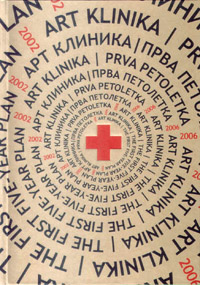
Illustration from the
book Art klinika - Prva petoletka,
Novi Sad 2007
|
 |
some outcry, but if Stalin can today move entire
people from one end of Russia to another, why
can't we do something similar with Arnauts".
There was no mention of material development of
Kosovo, "the heart and soul of every Serb".
The glorifying aura was therefore lifted from
the myth, and the myth itself was emptied of its
lofty contents. All that was left was its political
essence: a fight for Territory, ethnically clean,
Serbian.
Kosovo lost
long ago
Wars have been waged for the
territory, innocent people were killed on both
sides and Kosovo was really lost back in 1999.
Today even formally, politically and ethnically
so (two million Albanians and 150,000 Serbs).
Most Serbs, in fact, have no real emotional connection
with Kosovo, they never set foot on Kosovo's ground,
and the connection, if it still exists today,
owes its origin exclusively to the strong media
campaign.
Thus today, in April 2008, the few democratically
oriented persons demur to say publicly that Kosovo
is not the heart of Serbia. To say that Kosovo
is not Serbia, but definitely a new state in Europe.
To speak out loud that Serbian government is conducting
a policy of inducing violence, riots and cabal
in northern Kosovo in order to provoke Albanians
to respond to Serbian violence with even stronger
violence of their own. That the authorities dissipate
unjustifiably the money of Serbian taxpayers in
the crazy and fantastic hope that "Kosovo
will again be Serbian". To declare that young
swimmer Milorad Cavic is no national hero because
he wore demonstratively (at someone's suggestion?)
a T-shirt with Kosovo is Serbia slogan on the
victor's rostrum at the European Championship.
To explain that he is just a manipulated young
man, as are many others, who felt the whip of
Kosovo myth on his own back when he was disqualified
from competition, which caused him inexcusable
sports and moral damage. Citizens of Serbia, once
again hostages to the myth in the two centuries
of Serbian modern history, can be easily "disqualified"
from the process of Europeanization and modernization
at the very beginning of 21st century, and sentenced
to wait for a new chance, maybe in the next century.
If the Myth does not resurrect again, of course.
|
|
Zlatoje
Martinov |
1 Arnauts -
Turkish word for Albanians
2 Komitas -
Macedonian revolutionaries |