Prime Minister Kostunica said
that "the objective of NATO bombing of Yugoslavia
nine years ago was to create the first NATO state
in the world". Can this be true?
Dayton talks and accords entirely bypassed Kosovo
issue, because it was vital to win over Milosevic,
which would have been hard or even impossible
if Kosovo problem had been opened also. "To
be able to wrap up the deal, Holbrooke and his
team needed Milosevic's cooperation to apprehend
his Bosnian-Serb satraps, but they could not count
on him as actual partner and initiate the Kosovo
conversation at the same time. That is why Kosovo
was never on the negotiating table". The
United States supported Rugova in his fight for
primacy in Kosovo for a long time. "We strove
to promote moderate Albanians, by encouraging
the dialogue with Belgrade in the way of renewal
of Kosovo's autonomy, but we discouraged international
support for the UCK", Madeleine Albright
said. Even in the spring of 1998, the USA considered
UCK a terrorist organization. Special U.S. envoy,
Ambassador Robert Gelbard, declared this in Belgrade
on February 23, 1998.
In Contact Group's principles, which could not
be subject of negotiations in Rambouillet, two
issues were vital: territorial integrity of SRY
and high level of self-government in Kosovo.
Talking about objectives of NATO intervention,
both those proclaimed and the real ones, it should
be said that they changed as the situation unfolded
- starting from forcing Milosevic to sit down
at the negotiating table, through humanitarian
intervention (but only after he launched large-scale
ethnic cleansing of Albanians) to preserving NATO's
credibility and unity. There were probably some
other, undeclared goals, like toppling of Milosevic.
Independent Kosovo was not on the agenda, for
understandable and very pragmatic reasons. On
May 30, 1999, after Clinton received him, Rugova
met with Madeleine
|
Albright. Rugova said
their goal was independence, but they
could assent to status of interim international
protectorate or, he said jokingly, of
the 51st American state. Albright replied
that the USA could not support independence,
but would do all that was in its power
to provide autonomy and security for Kosovo.
Albright explained in a footnote in her
memoirs (Madam Secretary) why they would
not back independence: "Our unwillingness
to support independence stemmed less from
principles, but rather from the assessment
of regional views. Macedonia and Greece
strongly opposed Kosovo's independence,
fearing it may fuel separatist ambition
among their Albanians. Other countries
also had minorities aspiring for independence,
including Chechens in Russia, Abkhazians
in Georgia, Kurds in Turkey, Basques in
Spain. On a more general level, some Europeans
feared that independent Kosovo might become
a hub of Islamic extremism and organized
crime. We could not have achieved our
objectives in Kosovo without Europe's
support, and we
|
|
|
|
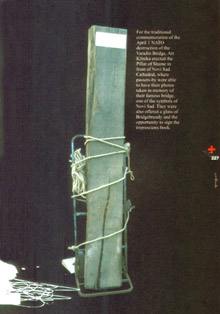
Illustration from the
book Art klinika - Prva petoletka,
Novi Sad 2007
|
 |
would not have received Europe's support had we
backed Kosovo's independence". Wolfgang Petritsch
said "it was clear that Milosevic could rely
on Contact Group's formula, because no member
of the Group wanted independent Kosovo at that
moment, no one wanted new borders in the Balkans".
That is why formula of essential autonomy for
Kosovo was adopted simply and easily, not only
in Rambouillet, but even later, after Milosevic's
defeat, in Resolution 1244. The formula did not
find its way into the Resolution, not in order
to incite Milosevic to accept conditions that
the international community had set, but because
at that moment no one, really no one, but for
Kosovo Albanians, wanted independent Kosovo. Neither
Americans, nor their European allies, or Russians.
This was the view that Americans and the NATO
held before and during Rambouillet talks and did
not change it during the intervention, but presented
it clearly to representatives of Kosovo Albanians.
At the beginning of intervention, Clinton said
the NATO's objective was that Kosovars would return
and receive "autonomy they had before Milosevic
took it away. That is my policy".
After the intervention was over, on June 13, Madeleine
Albright categorically repeated that stance in
the Meet the Press show: "We do not support
Kosovo's independence". She said she made
it clear to Hashim Taci, Ibrahim Rugova and Redzep
Cosja when she met them in Germany: "The
point is they'll have a very high degree of autonomy.
They will have elections within the context that
has been built". She did not say anything
about a referendum as a possibility to still influence
the change of status.
In an interview for Kosovo television on the day
the Resolution 1244 was adopted, Jacques Chirac,
asked if the autonomy may lead to Kosovo's independence,
replied: "We do not want independence for
Kosovo".
However, Kosovo's independence over the past nine
years practically became a reality, if not in
relation to the international community, then
definitely in relation to Serbia, which formally
preserved its territorial integrity, but was practically
expulsed from Kosovo. In that context it may be
said that the bombing did provide for independent
Kosovo, though the intervention did not set independence
as its objective. The united front of the international
community that high degree of autonomy was best
for Kosovo evolved steadily in the direction of
independence only with Serbia's defeat in the
war with the NATO.