Bosnia and Herzegovina is
still sown with mines and wounds. The mines have
been removed slowly, and wounds heal with difficulty,
while new ones are opened. This goes on like a
road leading to the end of the horizon.
Over the old wounds and mines, people keep adding
hatred and reawakening fears: primarily parties
which the Dayton Accords had to erase from the
political scene for Bosnia and Herzegovina to
embark unhampered into the new life. That is why
Bosnian citizens have been traveling for too long
on the road from insanity to common sense. Who
will bring the common sense, can it ever arrive
and, if so, when, is still unknown.
It is time again for local elections for representatives
and mayors, but few believe that the electorate
will be able to choose moral persons with sound
minds. There are too many sheep pens and rams
here, and we are still far from a real state and
rule of law. That is why Bosnia and Herzegovina
will remain a country without an address where
normal people could find secure cooperation of
any kind. Brussels is still making calculations
whom to support in this. This is the reason why,
in Bosnia and Herzegovina, the citizens are still
sufferers.
Most of the parties that struck the match to put
the powder barrel on fire in the nineties are
still present on the political scene. The new
parties are not much different from the old ones,
because they were all hatched under the same hen.
The life, hopelessly, drives around in circles.
What Serbian Radical Party Vojislav Seselj did
in Bijeljina on 14 September 2008 reminded of
the beginning of the bloody feast in Bijeljina
in 1992. Everything was the same, with the exception
of weapons and killings. The party president Mirko
Blagojevic, an extreme radical, and his buddies
threatened they would silence the Adhan (the call
to prayer recited in Arabic by muezzin from the
minaret) from the Atik mosque. Atik mosque is
situated in the downtown right next to the residence
of bishop Vasilije Kacavenda, on whose wink it
was destroyed, though newly built and still unfinished,
in 1993. The then president of the Executive Board
of Bijeljina municipality, Svetozar Mihajlovic,
signed the actual destruction.
It riles the radicals that they hear the loud
Adhan again and that the Atik mosque can again
receive the faithful. That is why the radicals
rampaged on the height of the election campaign
and in the time of Ramadan. Their goal was to
win voters of the same orientation who use the
same language of hatred, while bringing hatred
and fear among the Bosniaks, the Muslims.
To make it worse, Serbian Radical Party Vojislav
Seselj in Bijeljina and its president
|
blame Jusuf Trbic,
famous journalist and author and president
of the Bosniak cultural community Revival
in Bijeljina, for the loudness of Adhan.
It is tragic that Jusuf Trbic is accused
by Mirko Blagojevic, the originator of
Trbic's affliction and suffering during
the war. The inhabitants of Semberia still
remember well the war bacchanalia of Mirko
Blagojevic and his company. It was he
that, armed to his teeth, took Jusuf Trbic
from his house in the beginning of April
1992 and surrendered him into hands of
Arkan's
|
|
|
|
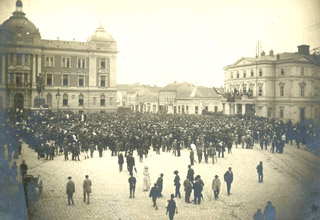
Citizens' protest over
Austro-Hungarian annexation of
Bosnia and Herzegovina, Theater Square,
October 1908,
Belgrade City Museum
|
 |
murders, who beat Trbic brutally. It was a miracle
that Trbic survived. Instead of being in prison,
like his boss, Mirko Blagojevic is still venting
threats, sowing hatred and provoking fear. In
Bosnia and Herzegovina, the murderers and thugs
still walk freely. Unfortunately, most of the
media in Dodik's entity support wholeheartedly
and fail to condemn such behavior.
Of course, no party, either the ruling ones or
those in the opposition, condemned the violence,
threats and sowing of hatred in Bijeljina by Serbian
Radical Party Vojislav Seselj and its leader Mirko
Blagojevic. Bishop Kacavenda, who witnessed, knew
of and approved all that, also failed to react.
This is the revival of the old scenario. As long
as this goes on, there will be no peace among
the people in Bosnia and Herzegovina. We know
who can profit from this situation. The crazed,
robbed, unemployed and humiliated citizens do
not need it.
Bosnia and Herzegovina is sown with wounds and
mines: this has lasted for long and without an
end in sight. It is difficult to walk in this
country, and it is even more difficult to arrive
at a state of happiness and a peaceful life. All
the while, Miroslav Lajcak continues to issue
mellifluous statements with the familiar smile.
Cry, beloved land.