Testimonies
from the trial for war crimes committed in the
Croatian village of Lovas
"A Legacy
for the Future"
Persa Vucic
During the four hearings (17 April - 09 September
2008) held in the trial for war crimes against
civilians and the indictment for "Breaking
the rules of international law contained in
the Fourth Geneva Convention Relative to Protection
of Civilian Persons in Time of War (12 August
1949)" raised against 14 persons accused
of murdering 79 civilians in the Slavonian village
of Lovas in October 1991, despite complete U-turns
in testimonies of the indictees, their minimization
or complete denial of their role in crimes committed
over Croatian civilians in Lovas, and though
the trial is not over yet, many things have
become clear. First of all, the fact that innocent
inhabitants of the village of Lovas were victims
only because they were Croats and owned large,
beautiful houses, and because Serbia committed
aggression on Croatia.
According to the 1991 census, the 73% of the
villagers were Croats and 7.5% were Serbs, but
even after the aggression on Croatia, there
were no even the slightest intra-national incidents
or provocations. Here are some undeniable facts
revealed at the trial, which is still underway.
Preparation
of the diabolic plan for expulsion of the Croats
Mirko Jovic (SNO), from Nova
Pazova, helped by Ljuban Devetak (1947, Lovas,
Croatia, holds economic high school degree, clean
police record, completed the school for reserve
military officers in Bileca and several courses
for intelligence and counter-intelligence officers,
Serbian resident, arrested on 28 May 2007) recruited
volunteers at the request of Dusan Loncar, the
then active colonel of the Yugoslav National Army
(YNA).
Devetak lied the volunteers claiming there were
around 300 Zengas (members of the Croatian National
Guard) in Lovas and that they needed to protect
the threatened Serbs who could be killed any moment
by the Croats.
Galenika pharmaceutical factory from Zemun, in
a valid clearance procedure, provided a
|
bus to transfer the volunteers
to Lovas. The volunteers went to Sid and
from there to military barracks where
they were equipped with uniforms, bombs,
arms and ammunition by the YNA. When after
their conquest of Lovas they moved to
Tovarnik, colonel Loncar supplied them
with an army transport vehicle that they
had to paint to hide its origin.
While they were on Galenika's bus on their
way to Lovas, M. Jovic and Lj. Devetak
told the volunteers that the Croats in
Lovas were amazingly rich
|
|
|
|
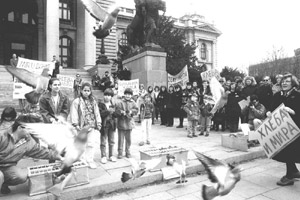
"Peace in Bosnia,
Spring in Serbia", antiwar protest
of Belgrade citizens, March 1993, photo:
Goranka Matic
|
 |
and their houses large and beautiful, claiming
that each volunteer would be able to choose several
houses for himself as soon as the Croats were
expulsed from Lovas.
Before the volunteers headed for Lovas, the Serbs
in Lovas were informed about the imminent attack
on the village. They were told to hide in their
houses and not to get out into the street or their
own yard for any reason: anyone seen on the street
or in his yard would be considered a Zenga or
Croat and killed at the spot. It was agreed with
the YNA that the army should fire ten grenades,
the tenth grenade being a sign for volunteers
and reserve forces to attack the village, as they
promptly did. Lovas Serbs, in agreement with Jovic
and Devetak, marked the Croatian houses with a
secret mark agreed on the night before the attack.
Unsuspecting Croats were watching TV or sleeping,
while the volunteers, supported by Serb reserve
forces, quickly conquered ("liberated")
Lovas. They immediately set on throwing bombs
on Croatian houses, but only on those that did
not have a basement - since a bomb thrown into
a basement would damage the house immensely, which
would be rendered useless for the Serbs who wanted
to appropriate it.
Three Croats were murdered in the attack. The
next day, in the basement of the building in which
Territorial Defense, the newly formed police station
and Municipal Council of the Lovas Village were
situated, a prison was set up. The volunteers
and reserve forces foraged the village, going
into yards of the Croats, incarcerated them and
started tortures. A curfew was introduced, as
well as mandatory labor on VUPIK company's estate
and the ban on freedom of movement for all Croatian
inhabitants. The Croats went to their assignments
accompanied by armed Serb volunteers and reserve
forces. Croatian inhabitants aged between 16 and
65, including women, were subject to mandatory
labor service. They worked in the steer fattening
farm, picking grapes and corn - but the expressions
"grape-picking" or "corn-picking"
among the volunteers and reserve forces meant
taking Croats into a vineyard or cornfield to
kill them.
The Croatian women that were not married, or had
been married but their husbands were killed or
imprisoned, had to take into their houses Serbian
volunteers or members of the reserve forces and
to live with them like husbands and wives. This
was presented on the news of the TV Beograd television
station as a proof that Serbia was not in a war
and that Croatian women from Lovas gladly married
Serbian soldiers, the patriots, who had "liberated"
Lovas.
"Take
her, f… her and kill her!"
Aleksandar Nikolaidis (1959, Pancevo, semi
qualified locksmith, served eight times, undergoing
another investigation of fraud, resident of
Serbia, arrested on 28 May 2007) testified he
saw Snezana Krizmanic (who was 15 at the time)
running out of the building where the Territorial
Defense, the Municipal Council and police station
were situated. She was completely naked, screaming
in distraught and is if in a trance, and ran
from the building onto the street and into some
shrubs, started rolling on the grass and acted
uncontrollably. Lj. Devetak also mentioned this
case and asked police officer Milan Devcic if
Colonel Slobodan Subotic had spent that night
in the room with Snezana Krizmanic. Some of
the other accused also mentioned Slobodan Subotic's
name along with Snezana Krizmanic's. Several
days before the incident, Lj. Devetak had brought
Snezana Krizmanic to Aleksandar Nikolaidis and
told him: "Take her, fuck her and kill
her" (a quote from the charges), which
Nikolaidis refused. Snezana Krizmanic told the
Croatian media, disclosing her full identity,
about the ordeal she went through in the night
she spent with Colonel Slobodan Subotic, and
she also gave a testimony for the Serbian War
Crimes Panel. Marija Djakovic and a few other
Croatian women that were raped in Lovas also
testified about those tantalizing moments.
Petronije Stevanovic (1952, born in the village
of Brdjani, Srebrenica municipality, Bosnia
and Herzegovina, has primary school education,
nickname Pera Louse, served five times, resident
of Serbia, arrested on 28 May 2007) testified
that Lj. Devetak enjoyed walking before a line
of remanded Croats, chatting with them with
a smile on his face. He would then suddenly
force a knife, hidden up his sleeve, into a
person's stomach. Lj. Devetak testified that
Petronije enjoyed ripping up legs of the Croats
and waiting for them to bleed to death. P. Stevanovic
testified that M. Jovic and Lj. Devetak promised
that all volunteers would be able to take a
few Croatian houses each, as soon as the Croats
had been expulsed from Lovas. However, the expulsion
did not go as planned, because the Croats offered
no resistance and even a murder of some twenty
Croats caused no intra-national incidents or
conflicts, while the Serbs killed a catholic
priest who advised Croats not to do anything
to provoke Serbs.
Lieutenant colonel Dimitrijevic spoke about
the YNA doctrine when he suddenly said: "I
knew about the mine field! And Lovas authorities
knew about it! The division commander ordered
creation of a quality minefield and a quality
map of it. Devetak was present when the mines
were planted. I know that the mines were planted
on 17 October 1991. That is why I told Peric
(Darko Peric, 1954, Valjevo, completed high
school, runs a private business, has been sentenced,
resident of Serbia, arrested on 29 May 2007)
to make a reconnaissance, not to search the
minefield, and to estimate whether he had the
experts who could assess where exactly the mines
were. I SAID that, but I did not ORDER that"!
"I
could have warned them, but I did not want to
interfere!"
"Peric had an entire
night to contemplate. Colonel Dusan Loncar was
commander of the Second Proletarian Guard Brigade,
which was subordinated to the First Proletarian
Division, and I came to Lovas as a volunteer.
Veljovic was First Class Captain and commander
of Valjevo squad. I saw they were taking Croatian
civilians toward the minefield, but I did not
think they were crazy to take them onto the mines.
I could have warned them, but I did not want to
interfere! Yes, it is true, I could have shouted
to them not to go into the minefield, but I thought
that Peric was not that crazy. Devetak decided
which Croat would walk into the mines. I was not
among the men who took Croatian civilians into
the minefield and I did not want to shout not
to take them there, I did not want to interfere,
I had nothing to do with it!
I was not in the group that took Croats into the
minefield and I therefore have no command responsibility"!
However, at the third hearing (09-13 June 2008)
lieutenant colonel Dimitrijevic changed his testimony
during the trial: "I knew there were a minefield
and a map of it, and I knew that some Croats died
there because they voluntarily laid on the mines.
I knew about the minefield - the army planted
the minefield, and the map of the minefield was
hanging on the wall of the office in Lovas. I
saw Darko Peric taking Croats onto the mines,
I could have stopped him but I did not want to
- it was not me that took Croats into the mines!
I had no business informing anyone they were going
to die; I was already packing, as I was leaving
Lovas on 19 October". "I knew nothing
about the planted mines, no one informed me nor
asked me about anything, I was nobody in Lovas,
they were thinking 'I don't give a damn about
lieutenant colonel Dimitrijevic', pardon my language,
your Honor! I had no idea that this Darko Peric
was taking Croats into the minefield"! "I
was in Lovas only as psychological support to
soldiers who were afraid and in crisis, and wanted
to defect: my role was to encourage them to stay".
Names most frequently mentioned during testimonies
were a captain Tito from Zenica, Colonel Slobodan
Subotic and certain captain Kovac ("The greatest
number of Croatian houses was set on fire when
captain Kovac was in Lovas", Lj. Devetak
testified at the second hearing).
At the fourth hearing (15-19 September) lieutenant
colonel Dimitrijevic felt ill due to his blood
pressure and the trial was adjourned on 19 October
2008, the next one scheduled for 15 October 2008.
|