Deputy president of the most
numerous opposition party, a professional MP,
a man who personified for many years the ideologist
and promoter of a retrograde and exclusive policy
that brought great damage upon Serbia, halted
on his safe road and stepped aside. He renounced
all his offices and roles, with a seeming simplicity,
like a person overcome by fatigue or whose strength
of conviction has faded. The unavoidable political
figure on the dirty and dark road which Serbia
threaded over the past years, a person always
ready to oppose any sense or progress, surprised
his supporters, opponents, political analysts
and citizens with his decision. His authoritarian
mental organization felt comfortable
following an intellectually
superior and better-educated leader whose
eloquence and extremism supplied answers
to all questions and resolved any dilemma.
In the tragic years of the bloody disintegration
of the
country, the big chaos and
social
|
stratification, it was easy to make choices,
because he took for granted that his Leader
was fearless guardian of the suffering
and the persecuted. He accepted dogmatized knowledge
based on the authority of faith, independent from
evidence, in line with assumptions and partial
relations with the reality. In the phases of social
disintegration, he formed his psychological
|
|
|
|
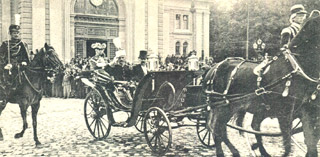
Petar I Karadjordjevic
upon his arrival in Belgrade from Geneva,
after the National Assembly proclaimed
him king, 18 June 1903
Belgrade City Museum
|
 |
integrity
through a system of belief in validity of the
Leader's ideas, which were construed on the "all
or nothing" principle. They together achieved
integrity of their ideas and ideology by trivially
simple and unilateral explanations that depicted
Serbs as victims, while the roles of executors
were cast for members of other peoples in the
common state and the international community.
Patriotism perceived as glorification of their
own nation was manifested as basic identification
with persons and values, and became the major
aggregating motive. Supported by an enviable number
of terrified and resentful followers, who managed
to survive in that permanent chaos by feeling
protected within a group based on firm subordination,
they organized themselves on the classic principle
of authoritarian groups with a marked role of
a leader whose ideas and orders were accepted
with fanatic blindness.
In the conniving times of war madness, the
deputy was satisfied with the role of the second
man, because the leader's charisma preserved
his inner integrity and the appearance of autonomous
personality. The Manichean doctrine of absolutization
of the good and the evil was engrained in his
moral matrix. These dualistic principles left
no room for conflict, because they were enhanced
by the aspiration toward the proclaimed greater
objective.
However, the fact that the Leader was displaced
in space and time imposed new roles and obligations
on the deputy. The dogmatic influence of the
chief in Scheveningen was weakening rapidly,
allowing the deputy to reveal his personal traits
and leadership abilities. During the election
campaigns, he modified the established rhetoric
and turned toward the social issues, which was
recognized and well accepted by the majority
of followers. He received support from hundreds
of thousands of people, who cheered for him,
shouted his name and carried his pictures. He
enjoyed in the frenetic applauses and felt he
was gradually emerging from the shadow of the
great Leader. He outgrew the Leader's influence,
felt free and powerful. It became increasingly
difficult for his authoritarian structure to
accept instructions from the Hague, he felt
more often the internal psychological conflicts
caused by the struggle between the subservient
and the liberated part of his personality. The
exclusive black-or-white mental matrix failed
to balance the two, inevitably generating the
internal war for emancipation from the hypnotizing
influence of the man he had followed for years.
He discovered hatred against the submissive
part of his personality and faced with ontological
crisis, which he overcome by letting loose his
personal traits that strove for absolute dominance.
Reorganization of the mental system annulled
the feeling of dependency and profiled a sense
of superiority that eliminated the possibility
for him to be anyone's deputy.
The anticipation of the leader's return from
Scheveningen jolted him into action, because
the newly discovered sense of superiority could
not stand the memory of the long-lasting subordination.
The former deputy party president did not change
suddenly his opinions on Europe, nor did he
outgrow the retrograde nationalism and autistic
insistence in his fate in numerous historical
misconceptions. He did not accept the penitent's
role and intimately had nothing important to
reproach himself for, because his introspection
took place on the level of hypertrophied narcissistic
traits that erased any jeopardizing and d all
stimulating sensation.
Struggling with himself, he destroyed the morbid
organization that had hampered and obstructed
any meaningful social activity for years. His
former party allies reacted with impotent anger,
which tied them even more tightly to the chief
in Scheveningen.
Apt in public appearances, with calmness and
the necessary degree of pathos pleasing to the
part of the auditorium that makes emotional
choices, he will undoubtedly attract very quickly
an enviable number of members of his once monolithic
and numerous party. With this radical move,
he definitely brought the Radical Party down.
Without the Radical Party as it used to be,
Serbian political scene will look much different
and, probably, more decent.