Dijana Markovic-Bajalovic,
president of the Competition Commission, and Verica
Barac, chairwoman of the Anticorruption Council,
have been going against the grain of the Serbian
government, which decided to get rid of the two
- and that hardly fits into the spirit of Serbia's
preparations for joining the EU. The government
sent them a "silken cord"1 that has
been waiting on its plate for a while, but it
appears that the time has now come to use it.
Instead of the institutions that made the two
ladies famous for their independency and incorruptibility,
the government plans to establish an Anticorruption
Agency. The Agency will swallow one more institution
- the Conflict of Interest Board, which also discovered
a series of bad moves made by the government officials
and MPs, who had been amassing their offices and
money. The Agency will have around 160 employees
and a director. The issue has become urgent, because
several months have passed since the elections
and appetites of deserving party members need
to be satisfied. A costly and inefficient party
machinery named Anticorruption Agency will now
be created instead of the three institutions that
took their job seriously and brought to light
many delicate cases of corruption, concentration
and monopoly, and showed how greedy the civil
servants and MPs were. The Conflict of Interest
Board expressed its view of the Agency two years
ago, saying it would be oversized and expensive,
while it would fail to deal with corruption.
When the government adopted the antimonopoly law
and set up the Competition Commission, it probably
did not expect that a commission would bring so
much trouble. The Commission, namely, touched
the untouchable tycoon Miroslav Miskovic, proving
that he held a monopoly and covered more than
50 percent of the Belgrade market - the relevant
market for the Commission, where Delta stores
dominated both in size and number. The public
was outraged, while Dijana Markovic-Bajalovic,
the Commission president, a brave, well-spoken
and good-looking blonde, turned to be a hard nut
to break. Serious authorities immediately took
Miskovic's side, trying to prove the Commission
was wrong by failing to apply the law or define
a relevant market, and claiming he could not be
a monopolist. Apparently, he had strong competition,
such as
the green market or
the
|
corner shop. This was the gist of
the study prepared by the Faculty of Law,
written by professors and doctors of law
Vesna Besarovic, Mirko Vasiljevic, Gaso
Knezevic, Boris Begovic, Dragor Hiber
and docent Vladimir Pavic. We say the
Faculty of Law, because the study contained
the school's letterhead. Verica Barac
told Republika: "When the Anticorruption
Council saw the study, we asked to see
the contract signed between Delta and
the Faculty of Law, but they failed to
comply. Only when we took the issue to the |
|
|
|
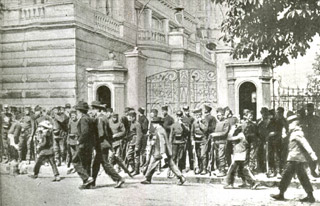
Belgrade Battalion Troops
in front of the Court, the morning after
the assassination of King Aleksandar and
Queen Draga,
12 June 1903, Belgrade City Museum
|
 |
Commissioner for Information
of Public Importance Rodoljub Sabic and after
his intervention, we were given the contract,
but it did not contain the actual figure paid
for the job". The other study, which also
proved that Miskovic was not a monopolist, was
prepared by the Serbian Chamber of Commerce (the
then Minister of Trade Slobodan Milosavljevic
was the Chamber president at the time) and private
company Konzit, owned by Slobodan Milosavljevic
and his wife - Verica Barac warned. This study
also concluded that Miskovic's Delta was not a
monopoly and that Miskovic held a 10.5 percent
share of the Serbian market, and 23.5 percent
in Belgrade. How can the conclusions be so different,
when both bodies invoked the law? "This is
made possible because the persons that prepare
these projects also write the laws that contain
"holes", and then the same professors
and neoliberal non-governmental organizations
sell their explanations of the holes to tycoons.
The same people play different roles", Verica
Barac explained.
The polemics about Miskovic has lasted for two
years and it continued even after the Supreme
Court decided in favor of Delta. The minister
Milosavljevic said recently that the Office of
Statistics published the information that Miskovic
was not a monopolist and that the Office of Statistics
was the only authority competent to judge on monopolies.
With this, the minister of trade denied the Law
on Protection of Competition and the Commission
itself, though the government established it.
Who is now to be held accountable that the money
was dissipated to write the law, to finance the
Commission and the trial, when the only competent
authority is the Office of Statistics? This reminds
us of the time when Velimir Ilic, the former minister
of infrastructure, purchased train engines without
a tender "because the law was faulty",
Verica Barac said, adding "the citizens pay
for Delta's monopolies every morning, enabling
Miskovic to fund various political parties".
Our institutions are imploding, their destruction
being managed by some members of the government.
Minister Dinkic participated in the fall of four
governments and is a specialist for shortcuts.
"Bankruptcy Mafia" in courts, "legislation
guillotine", the National Investment Plan,
the closing of domestic banks, the sale of Nacionalna
Stedionica - they were all his achievements. When
the Anticorruption Council discovered the Sartid
scandal, Dinkic said the Council was made of "wailing
old women". Sartid was sold to US Steel,
and now the government ignores the fact that there
are expensive litigations underway with German
and Austrian companies regarding their claims
on Sartid. While in that case the authorities
did not care about developments in the Commercial
Court, when judge Kljajevic affronted the authorities
over the C Market, he became the "bankruptcy
mafia", was arrested and held for two years
in remand prison "as if he were a war criminal",
Verica Barac highlighted.
Does it really come as a surprise that after all
that happened the citizens despise institutions?
Have not the toying with institutions and their
public disgrace sent a message, between the lines,
to the authorities - that all depends on them
and that the vital thing they lack is trust? The
plans to abolish the Competition Commission, Anticorruption
Council and Conflict of Interest Board are just
a fraction of the sad story about how a road of
change and a road to Europe can end in a cul-de-sac.