Values - before
and now
The 1968: thrust
and lies
Certainly
it was not possible to produce the values and
reproduce the shame with which we have been
living for the last twenty years, from the values
of 'the student 68'. The values of the 68 have
affirmed life, and values of our twenty-year
old shame are those that affirm destruction
and auto destruction
Alija Hodzic
The Belgrade student protests of 1968, ever
since then, in spite of the radical change of
the political system, had been disputed by the
two main delegitimistic strongholds. The government
immediately "found" their background
and gave basis for the interpretation of student
strivings.
Underlying
of nationalistic background
The news on the background had no public character.
It was spreading through the party networks.
The matter was, such news was spreading out
in the party networks that Belgrade students
were proteststing to support Dobrica Cosic,
whose public speech at the time addressing the
situation in Kosovo was officially labeled as
Serbian nationalism. Thus, the student protests
got the same label, which have bound them with
the so-called unitarism and Serbian hegemony
in the political culture. This was a way of
delegitimating the Belgrade student protests
at their start, and even today (outside of Serbia)
this background is assigned to the protests
(Serbian nationalism, unitarism, and Serbian
hegemony). Today, or in the last twelve years
this story does not have the same meaning as
it had at the very beginning. Some participants
of this riot welcomed the story of nationalism,
as a proof that in the past they were like what
is desirable today. Nevertheless, they do know
that it would be such a big lie, and it would
be difficult to cope with it.
Attribution
of 'uravnilovka'
The interpretation of student strivings and
their meaning was public, unlike the news on
the background of the protests. It was spoken
of at public meetings and published in the press.
'Uravnilovka' is the main purpose of what Belgrade
students are trying to achieve with their protests.
That is by what they are driven. This is what
the closest formula would be like, formula with
which the student strivings were tried to be
delegitimated. Back then this was opposite to
the economic and social reform the basic "political
philosophy" of which (in order to increase
the social productivity, efficiency, i.e. welfare)
was to increase the social differences. The
criticism of inequality based on privileges,
the criticism of the society that based the
social standings of people on their political
power (thencefrom the criticism of "dukes
of socialism") aimed at the necessity of
the political reform. This would have, of course,
been the political reform that would last, as
such was the direction of the majority of student
strivings, not the only direction of student
strivings, within the thorough legitimate values
of the "socialism with human face".
This very criticism was to be shown in a way
that basic student striving would be placed
in a story on political radicalism and primitivism
of "our China people" and a handful
of rice for all.
Tendency
to establish democratic society
Disputing the student strivings
did not develop from these two delegitimiting
strongholds only. However, these two although
with changed purposes, became permanent. Moreover,
there were quite more at the beginning: from accusations
of being hooligans to accusations of being connected
with external enemies. From the very beginning,
the interpretations of student demonstrations
became their integral part. Thus, all the events
|
(new conflicts, meetings,
gatherings, choice of strategies - all
methods of University strikes) become
part of what could be called struggle
over the interpretation. The striving
was to articulate an ambition that could
have become the subject of public dispute
in a way that would not have been refused
apriori (one of the first requests, connected
with the democratization of media is the
request to "form public opinion"),
to impose it as socially legitimate position
and establish the communication, basing
it on some fundamental values of the society.
This striving is laden with some interrelated
double pressure, internal and external.
Externally the student initiative was
trying to present itself as socially unacceptable
and even hostile action, and consequently
in order to uphold the initiative, there
was a tendency to emphasize internally
socially acceptable symbols and suppress
such events (so-
|
|
|
|
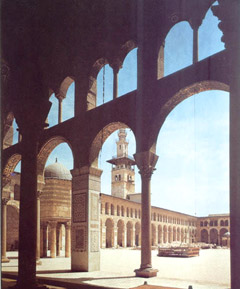
Innenhof der Großen
Moschee in Damaskus mit dem viereckigen
Minarett im Hintergrund
|
 |
called extremists, provokers, etc.) that outside
initiatives could use for their own purposes.
Such pressures - "cunningness of the system",
in various ways were acting in order to discipline
the student movement, to deprive it of its initiative
and merge it into the mechanisms of the actual
political life. In the beginning it was all about
enemies (nationalism, links with external enemies),
then about brutes, outcasts and thieves. Soon
they were labeled as people who had been trying
to achieve their legitimate requests in an illegitimate
manner. Later on, the party "Directions"
born in the student protests motives were imposed
on students as a substitute for their programmed
designed during the protests at the University,
all the way to the isolation of now "hostile"
minority (settlement with student press, arresting
students, and later laying off eight professors
of the School of Philosophy). The struggle over
interpretation was at the same time a struggle
over "the main thing" of the protests
and what was to follow afterwards. The thing was
that the students proclaimed themselves into an
authorized portparolle and they tried to institutionalize
and uphold that. From the very beginning, until
its end of the student movement this was the central
place of dispute. If this was not completely recognized
from the very beginning, if this was interrupted
by various actual "misleading" (hooligans,
thieves, enemies, etc.), this was immediately
and clearly seen after the protests ended, and
when the government tried to eliminate the protests
by integrating it into the "Directives",
and thus made it void. The students did not accept
that, they wanted to preserve their autonomy at
which they had based themselves as an authorized
portparolle, as the one who can be the subject
of legitimization. This was the very basis of
the dispute. It was an attempt to introduce a
non-party political pluralism.
Resistance
to Violence and Lies
At the very beginning of demonstrations, on
June 3, the University Board of Students' Association,
the newly formed Action Committee of Demonstrations
and the Student paper editorial board adopted
in the Student Campus a Resolution on Student
Demonstrations, citing the reasons of the student
protest (unemployment, social inequality, stratification
according to job, democratization of political
and public life, freedom of the press, gathering
and demonstrations, university reform etc.)
and also the "Declaration to Belgrade Students
and Citizens", demanding dismissal of directors
and editors in newspapers, radio stations and
other media (because, they said, their reporting
on the demonstrations that took place over the
night and in the morning were "outrageously
mean", while the "information was
unscrupulously false"), also calling for
removal of police and political officials responsible
for "savage and indescribably cruel police
action". The demands were directed against
injustice, non-freedom, violence and lies. The
student demonstrations were too wide and varied
to provide legitimization for any political
party or option today. The mainstream, at least
concerning public action, strove toward democratic
socialism. Against violence and lies, for justice
and freedom.
The values of '68 affirmed life, while the values
of our twenty years of disgrace have been those
affirming destruction and self-destruction.
|