Serbia has for a while been
shaken by serious disorder within the Church,
which has in the meantime "overflowed "
into the society and become a serious problem.
From Cacak to Uzicka Pozega, via Arilje and Kosjeric
to Belgrade, there have been rallies of religious
extremists, mostly zealots advocating long obsolete
forms of liturgical practice. By their characteristics,
they are entirely like Wahhabis in the Muslim
community, including their appearance. They reject
even small changes, while seeing in some, even
the slightest, reforms the betrayal of the Orthodox
faith. There was even a conflict in the village
of Duskovci, where the bishop of Zica, Hrisostom,
was attacked. Expressing their protest, they sat
in churches, while some priests went on hunger
strike. The civic media have been baffled and
it is understandable, because the Church has its
own legislative power in the Holy Assembly and
its own judicial power, but lacks executive power
- the state has to send strong police forces to
restrain protesters, but no law regulates the
situation or
|
method in which the
state could execute decisions of church
bodies. The troubles there can only grow
and there will be no peace anytime soon.
Zealots are no longer small patches of
"wahhabis" on the road, but
well organized pressure groups focused
both on the state and the Church. It is
enough to look at the Revnitelj magazine
- their publication - and at the behavior
of their "bishops". They present
themselves as the True Orthodox Church
in Serbia. They never said whether they
were registered and, if so, where. Serious
conflicts concerning Stijenik monastery
serve as a warning that even the worst
scenarios cannot be excluded. The serious
and alarmingly worded statement signed
by archpriests of the towns mentioned
- published in Pravoslavlje paper on 1
July 2008 - did not offer much to either
the church or civic readers. It spoke
about groups and "vandal hordes"
that disseminated evil and contained "features
of Cathar and Messalian heresy".
How did that get into
|
|
|
|
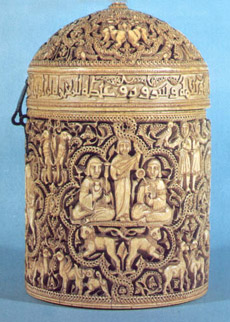
Elfenbeinpyxis mit
dem Namen el-Mughiza, datiert 968. Cordoba.
Louvre, Paris
|
 |
Serbia today - when the last traces of the two
dualistic sects disappeared late in the 13th century
with Bogomiles. Some businesspersons were mentioned,
and also a member of the League of Communists
of Yugoslavia Central Committee who graduated
in Zagreb and, as always, some communists who
- according to this, have grown in numbers, but
it is unclear how they got into the Church. They
fail to see the boundary between canonic and civic
law and see in everything the sad consequences
of a forced clericalization, the tool used by
the people who surrounded the former Prime Minister
V. Kostunica. There seems to be a division even
among the bishops, because the text said that
some "persons carrying a klobuk on their
head" were behind this.
Zealots do not want any reforms in the Church,
nevertheless, all this was a consequence of the
fact that there have been no reforms in the Serbian
Orthodox Church, just like there have not been
many reforms even in the entire area covered by
the orthodox part of the ecumene. There were few
institutions in human history that went through
greater reforms than the Christian church, but
the Serbian Orthodox Church is far behind - very
far, indeed. There are many models to look upon,
but the Serbian Church appears as if it did not
know about them.
The problem is that these are not just "church
subjects" - they are related with the cultural
template and its unfinished form in the Serbian
culture. The Church is a part of the society and
a considerable fraction of the society is not
indifferent to developments inside the Church.
There are many examples to support this, the latest
being the newly-formed government, in which the
new minister of religions is Bogoljub Sijakovic.
We still do not know how he will deal with the
Law on Churches and Religious Communities. Serbian
ombudsman Sasa Jankovic promised already in January
that he would "initiate a public discussion"
about it, because the law has a flaw - its application
may cause disaster. The new minister, however,
is a man who presented himself long time ago -
see Pravoslavlje paper, 15 February 2006 - as
a man with a singular understanding of history
and culture. The science - said B. Sijakovic -
"would not be the right path to reveal the
full significance of St. Sava legacy". In
the same text, Dr Sijakovic was even more specific:
"Therefore, ethnography is insufficient to
describe the Serbian people: it is best described
in hagiography of its Christ-bearing saints".
When it comes to cultural templates, we have not
had much success either in the Church or in the
state.
(1) St.
Vitus Day (Vidovdan in Serbian) - the day when
the Battle of Kosovo, between Serbia and the
Ottoman Empire, took place in 1389. Though the
Serbian side lost, the day commemorates the
martyrdom of the soldiers and the "victory
of the heavenly over the earthly kingdom".