In the chains
of wild capitalism
In order
to bring a bit of order into the field of labor
the state should primarily bring its institutions
into order -such as the Privatization Agency,
commissions and ministries which decide on privatization
and destiny of employees. Otherwise it is going
to be difficult for the state to prove itself
socially responsible, as it declares to be
Olivija Rusovac
The privatisaon has launched a new class of
owners onto surface, those who have bought the
former socially owned enterprises. Most of them
are familiar only with the law of force and
contempt positive laws. Weak and often too friendly
inspection and notoriously slow justice, low
awareness of the employed and their poverty
that creates slave like dependence due to one
form of the wild capitalism is only aggravating
such situation.
Political
rights yes, labor rights no
And while the term human rights
has so to speak entered all homes so that even
children know it, worker's and social rights are
considered something else, as if they were not
part of the human rights, so that the worker can
have political rights at the elections, but no
rights at his work post. The International Covenant
on Economic, Social and Cultural Rights, that
Serbia took over as an heir of the SFRJ, who ratified
this document, bridges this artificial separation.
The European Union decree of 1996 belongs to this
corpus as
|
well, as one of the
key documents of the European Council.
This document is ratified by the member
states upon joining the EC. Even though
Serbia has been its member for a long
time, it has not ratified the European
Social Decree that would be important
link in the improvement of economic and
social rights in our country. There are
several investments dealing with improvement
and protection of those rights in Serbia.
They are Agency for Peaceful Labor Disputes
Resolution, Ministry of Labor and Social
Policy with the Department of Labor and
Directorate for work safety and health,
Ministry of Justice, unions, courts and
municipal legal help.
Vera Božic-Trefalt from the Directorate
for work safety and health says that EU
has nineteen decrees that we have to transfer
into our health care. The Law on labor
safety from 2005 is brought into line
with the EU regulations, but the EU Commission
is going to give its final
|
|
|
|
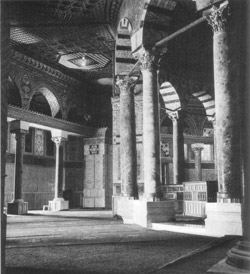
Innenansicht des Felsendoms.
Die Mosaikmotive zeigen deutlich hellenistischen
und sasanidischen Einfluß
|
 |
estimates, however only after the Agreement for
Joining the EU has been ratified. However, no
one denies that despite of the regulation and
institutions the field of labor is not regulated
and poses a difficult terrain for the human survival.
The employers do not respect human life, and for
them a worker with helmet and gloves is a cost,
let alone other rights. The labor inspection is
entirely separate story. There are only 308 inspectors
for as many as 28 counties. From unions we hear
that inspectors are not immune to corruption and
"conniving" at the employers. Vera Božic-Trefalt
points out that last year there were three serious
accusations at the expense of inspectors and that
there were more than two hundred telephone complaints.
Ina addition, when an inspection presses the charges
very limited number is processed, says Vera Božic-Trefalt.
Asked how many managers end up in prison due to
the suffering of their employees she replies:
"If you get an answer on that one from those
responsible, I'll buy you a lunch ".
State institutions
are not innocent
According to the data from
the Center for democracy, every seven minutes
in Serbia one worker is injured, each week there
is a death case at work, and almost thousand workers
became disabled due to the work injuries. According
to the same research, Serbia is very much behind
the European countries when the work safety conditions
perception is concerned. Economic and social issues
are realized in the state-business-citizens triangle.
What has been going on in this Bermuda's triangle
during the last eight transition years, we learned
at the Anticorruption Council. The Council received
thousands of workers due to poor privatization
and inhumane treatment of workers and property
by the new employer. We should remember the case
of "Šinvoz", "Jugoremedija"
and its now former owner Jovica Stefanovic Nini,
the sugar plants bought by Miodrag Kostic, oil
refineries of Predrag Rankovic Peconi. The documents
and statements made by employees give testimonies
on legal horror created by these new wealthy men
- from reallocation of workers so that they had
to travel even hundred kilometers to their work
and back, to hiring private police for the factory.
Long mistreatment not only at work but in state
institutions even, made people desperate so that
in "Šinvoz" only five workers died or
killed themselves, while many people got ill.
There is a Socio-economic council as one of the
institutions for counseling between the state,
employers and union, but this is a paper institution
used for taking photos of and making propaganda.
At the moment we are at a dead end, says Sidonija
Vukotic from the independent Union, being a victim
of "shooting" herself, because allegedly
she turned in some important documents of "Investimport"
to DOS, due to which she has been suing her former
company for seven and a half years now. She reminds
us that the General Collective Contract has been
signed, but it is valid for the members of the
Union of Employers and the labor unions. However,
this is only one tenth of the employers, Misa
Ivanis from the Independence union points out,
who also gave us an astonishing piece of data
that the Business Registers Agency refused to
give the list of enterprises members of the Union
of Employers, so that these ten percent of firms
are- a secret. Both Vukoticeva and Ivaniš point
out that the Minister of Labour Rasim Ljajic should
sign a regulation on "expanded action"
(of the General Collective Contract), which means
that it will include all employers and enterprises.
Maybe things are going to improve after this signing,
so that workers would free themselves from fear.
|