Perhaps for the first time
after eight years of the transition turmoil in
Serbia, this year on the realistic horizon the
reindustrialization appeared, as an essential
objective of the transition itself. Announcement
of the Italian Fiat's return to Kragujevac, town
in which during the second half of the previous
century developed and culminated "screwdriver
industry" in Serbia, not only sounds promising
(the business is 1.2 million Euros worth), but
it also suggests that the large west European
corporations have finally estimated the possibility
of starting with long term projects in the real
economy sector.
Fiat's signal is important not only for other
large international industrial investors, but
even more for the Serbian economy that, in the
last four years, owes its relatively high average
real growth rate of 6.9 percent (2004-2007) primarily
to the financial and tertiary sectors - not to
the production.
Even last winter, at the annual Kopanik Business
Forum, that is increasingly becoming the most
serious counseling in the area of our economics;
many papers raised the issue of "reindustrialization".
Even among our economic experts, the opinion that
without a rational return to the real production,
primarily to the industry, the necessary high
economic growth rate of Serbia in the next decade
is not going to be sustainable. That is, all attempts
of the government economic policy in the last
seven - transition years to prevent the growth
of unemployment with some radical investments
- so far have resulted in only 200,000 new work
posts, mainly in the small private sector firms.
In the same period even 515,000 work posts have
been closed (from September 2001 to September
2007 the number of the employed in Serbia reduced
from 2.787,800 to 2.502,500). Without reindustrialization,
obviously, there is no dynamic new employment,
nor "sustainable development" in whole.
Nevertheless, still high "transition deficit"
of Serbia in 2007 compared to the year 1989, that
amounts to 34 percent aproximaly (the level of
gross domestic product in 2007 was 66 percent
of that from the 1989), we primarily owe to the
catastrophy of Serbian industry during this period.
According to the data of Serbian Statistic Agency
(taken from the analysis of the Center for Strategic
Economic Research "Vojvodina-CESS" in
Novi Sad), the level of industrial production
in Serbia in 2005 was only 52.2 percent of that
production in 1990. We are talking here not only
about twenty years of stagnation, but also about
a drastic deterioration that has only partially
been stopped, and that is simply unsustainable
for a European country in the 21 century.
During the full transitional period between 2000
and 2004, the industrial production in Serbia
grew at the average rate of only 1.3 percent,
and in the last seven years at the average rate
of about 2 percent - and this is due to the inclusion
of the entire statistical period, not to the real
recovery or progress. In addition, the share of
the industrial production in the total social
production in 1990 in Serbia was 42.9 percent,
while until 2004 it fell down to 35.7 percent,
and we expect that this share further deteriorated
up to date (problem with the comparability of
data is still high, because of the change in the
|
statistical methodology
for monitoring almost all indicators).This
conclusion may be drawn primarily from
the permanent inadequate share of investments
into industry during the entire transition
period- so that, for example, the share
of investments into infrastructure in
the total investments in Serbia between
the 2000 and 2004 amounted to only a bit
more than 30 percent of the total investments,
while in the recent years it is even lower.
Available data indicate that inside the
industry itself during the transition
period considerable changes occur at the
expense of transitional industries, with
the exception of food industry and construction
material production. Actually, the structure
of industrial production in Serbia is
getting "poorer" - the electrical
industry accounts for as high as 25 percent
in the total production, and when the
food and
|
|
|
|
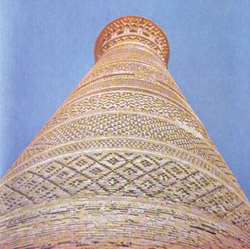
Minarett der Kalan-Moschee
in Bukhara. Es handelt sich um eines der
schönsten Minarette der Timuriden-Zeit.
Nach einer Inschrift stammt es aus dem
Jahre 1127
|
 |
beverage production is added (22 percent of the
share) we get a half of the total industrial production.
Therefore, the entire chain of not only traditional
but also new industries in Serbia does not exist
at all.
What fundamental conclusion is to be drawn from
these (incomplete) data on the faith of industrial
production in Serbia in the last 20 years, and
even in the last eight transitional years? The
first conclusion, even without any hyperbolic
emphases, is that Milosevic's regime destroyed
Serbian industry (and not only the industry of
course). Second, with its so to say "brokerage
model" investments of fast return of capital
in the recent transition years Serbia was developing
primarily due to the foreign portpholio investments
inflow, and these were mainly allocated in the
businesses such as banking, trade, real estate,
marketing, media, representative agencies, which
as a consequence has a constant growth of foreign
trade deficit and strengthening of financial-trade
lobby in the country - motivated to protect the
system in which no domestic production even pays
off.
Of course, it would be ideal if Serbia too, alike
most developed countries in the world, a bit "decadent"
economies, could base its further economic development,
as the experts say, on the "conceptual basis",
IT innovations, and not on the development of
physical component of the economy, that is industry,
but such expectations are too optimistic and irresponsible.
It is interesting to notice that we have again
given up on the industry in some ways even after
the "democratic turnover" in the 2000.
We should remember the Economic Development Strategy
for the period between 2002 and 2010, designed
in 2001, in the design of which 380 experts from
60 research and expert institutions participated.
First, the Serbian Government has never adopted
this Development Strategy, so that it never became
official. Therefore, in this unofficial strategy
for the period 2002 - 2010, it has been accounted
for the total eight-year investments of 32,947
million dollars and it was explicitly counted
on the foreign loans. However, out of the total
projected investments of around 33 billion dollars
for the, back then, approaching the "eight-year-period"
- 12 billion dollars was foreseen for telecommunications,
8.3 billion for energy, and 5 billion for the
road infrastructure. For the classical industry,
and for the new one even - practically nothing.
If we take a better look at the structure of the
projected investments of about 33 billion dollars,
it was planned that even 25.3 billion dollars
(or 76 percent) are invested into infrastructural
systems that would be important for Europe. Simply,
reindustrialization was only in the stage of preparation
- or better say should have been in that stage,
but in reality, the plan for infrastructure was
not prepared (except that the production and transmition
systems for electrical industry have been repaired).
In addition to it, with thus structured investments
it was estimated that the average eight-year GDP
growth rate in Serbia, starting with the year
2005, would be 8.55 percent, which would have
increased the annual GDP from 10 billion (in 2000)
to 15 billion, and until 2010, at such a growth
rate it would have reached 22.7 billion dollars.
Thus, it would have been the same as the one Serbia
had in 1989. Seemingly, all this has not only
been achieved already but exceeded, since it was
estimated that in the last seven years, as Miladin
Kovacevic stated on May round table of the Center
for geostrategic research in Belgrade, around
45.5 billion dollars arrived in Serbia - remittances,
foreign investments, loans and donations. Still
Serbia has not reached the green branch, since
dollar in the meantime depreciated so much that
it would be difficult to perform real comparisons.
Still, as we have already pointed out, the GDP
level in Serbia in 2007 was only 0.66 of the level
of the GDP level from 1989.
What was clear even from the strategy of 2001
was that out of almost 1,109 business facilities
under construction, with 80 percent of completion
level, almost none industrial facility was finished
and put into use. All earlier construction efforts
were in vain. In addition to it, we should bare
in mind that the degree of use of industrial capacities
in Serbia between 1989 and 1998 went down from
76 to 36 percent, which simply drives us into
conclusion that it had stayed without high customs
protection, and consequently without consumers,
and eventually without enough energy and raw materials
- so it had to collapse.
Even if we take a look at the industry's position
in the newly designed National Strategy of Economic
Development of the Republic of Serbia for 2006-2012,
designed towards the end of 2006, the model
of reindustrialization was not developed most
diligently, since it suggests large government
mediation as an investor, so that beside the
conservative scenario of new employment trends,
productivity and gross domestic product, there
is also the development part that, in the opinion
of this article's author, counts too much on
the government's (NIP) incentives. Even this
development scenario gives projections for the
employment growth (only for the period 2008-2012)
of only 140,000 people (meaning it forecasts
the employment growth rate of only 5.9 percent).
How to industrialize Serbia in the forecoming
years when the government, after a series of
elections, seems to be returning to the inflation
model of covering the growing consumption and
after concealing the problem of increasingly
dearer raw materials and inputs from the world
market? Of course the task is not simple, but
it now becomes the key objective of the "proeuropean"
coalition, allegedly formed in the Parliament
of Serbia. Actually, two things are most probably
the most important - first is that Serbia gets
the wider support from the European Union for
the development of its industrial policies,
and the second, that West European investors
gain confidence in that Serbian strategy for
a longer time period will not widely balance
between west and east orientation.