During the new government
constitution, president of Serbia Boris Tadic
has announced the necessity of 'national' that
is 'historic' reconciliation several times. The
media announces that there is even going to be
some "Declaration" signed. What that
actually means, Tadic has not completely explained,
nevertheless our political leaders never do completely
explain their actions after the elections end.
Bearing in mind his party's necessity to form
coalition with the Serbian Socialist Party- the
main culprit for the latest Balkan wars during
the nineties and all the troubles of the Serbian
society that had issued from them - Tadic's pragmatism
is more than clear. However, even legitimate as
a political tool, the pragmatism itself has its
limits. These limits lie in the sphere of general
moral norms that are to be obeyed by all those
normal and decent, including the politicians.
These limits also border the negative heritage
of Milosevic's regime that is, the peace and war
criminal justice Corpus of the problem with which
for the last eight years - ever since the October
fifth changes - Serbian society has been dealing
with not successfully enough. The time for true
facing of this problem is only ahead of us. The
fact is that the Serbian Socialist Party was not
really reformed. According to its present leader
and the Vice President and Minister of Interiors
(!) in the Serbian
|
government - Ivica
Dacic, the Party remained loyal to the
ideas of Slobodan Miloševic and the main
principles of his domestic and foreign
policy. It is not surprising that Dacic
is advocating the European integrations,
because we must not forget that Milosevic
also declaratively advocated the European
Union and peace. However, in reality he
did everything opposite to his public
declarations. The attitude of the today's
Serbian Socialist Party towards the deeds
of Milosevi's politics is easy to perceive
from its political actions up to date
(for example the recent advocating banning
the "non-patriotic" NGOs, like
in Putin's Russia), but also from the
value judgments on that politics coming
from its leaders, primarily from Ivica
Dacic and Milutin Mrkonjic. "Milosevic's
politics was correct, and it's you Democrats
who came closer to that politics, not
the other way round"; and "Why
did you tear us down after all on the
fifth of October, 2000, when back then
just like today we had been on the line
of preserving Serbia as a country
|
|
|
|
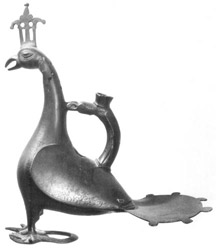
Aquamanile in der Form
eines Pfaus. Bronze. Wahrscheinlich sizilianische
Arbeit, wie aus der Inschrift auf der
Brust des Tieres ersichtlich: "Opus
Salomonis erat" und "angefertigt
von Abd el-Melik dem Christen". Fatimidisch.
11. Jahrhundert. Louvre, Paris
|
 |
and leading patriotic policy", were the words
of both of them just a few days before the new
government's formation. No reaction to this came
from the Democratic Party, or its president. Was
this one sort of the "historical" reconciliation,
all in order to remain in power by all means,
even with yesterday's worst political enemy? Two
months earlier, during the presidential campaign,
while persuading his voters to vote for the "European
Serbia", that is the Democratic Party as
its incarnation Tadic literally said: "There's
no return to the nineties, we are never going
to allow that, we are never going to be sided
with those who led this country into pointless
wars; Serbia is sick of poverty and misery, brought
by the politics of socialists and radicals during
the nineties." (Danas, 7. 05. 2008).
However, we should leave aside the political inconsistencies,
which are the only consistent political constant
in Serbia. It is far more important not to forget,
by this pragmatic politics the darkest past -
war crimes, robberies, as general features of
that past, produced by the Socialist Party as
the major and the actual ruling party from 1990
until 2000.
When a party self-critically reflects upon that
period of its activity, when it condemns the politics
of its former leader loud and clear, and when
it condemns all misdeeds done to others and themselves,
only than we could talk about the "national
reconciliation".
Second but not less important repercussion that
keeps deriving from concealing shameful Miloševic's
wars and crimes performed by some individuals
in the name of Serbs would be a rehabilitatation
of fascist colaborists during the World War II,
among which are Nedic, Draža Mihailovic, Ljotic
and some dignitaries of Serbian Orthodox Church.
For example, Mitropolit of Skopje Josif (who was
substituting the imprisoned Patriarch Gavrila)
in presence of the German military lieutenant
and president of the "national salvation
government" Milan Nedic, every year in the
Saint Sava day cut the ritual cake in the Saborna
Church in Belgrade, without any public condemnation
of the Nazi occupation and Nazi crimes.
It is necessary to say loud and clear - there
is no reconciliation with the Nazis and its followers!
Then, add immediately - with fascistic crimes
of Karadžic's and Mladic's Serbs there is no reconciliation
neither, and there is no reconciliation or compromising
neither with them nor with those like them (Hadžic,
Arkan, Bokan). Otherwise, justifying Miloševic's
wars for creation of the "state of all Serbs",
due to the similarity of ideologies is leading
to the legalization of the monstrous state creation
such as the Nedic's Serbia, which had been conceptuated
as a home of Serbs only (without Jews and Communist
because Nedic without a trace of remorse was diligently
extraditing Belgrade Jews and communists to the
Nazi leaders in the Staro Sajmiste Concentration
Camp).
Thus, if the critical reflection on the last sixty
years of the Serbian history does not happen in
the nearest future, if the political interests
of the present "Europeans" do prevail
over the moral ones - the essentially moral ones,
such as the truth that killers and (war) criminals
belong in prison - this would mean that Serbian
society even today, when it allegedly wants to
join the Europe, does not differentiate between
good and evil, sublime and shameful, and also
between actual and fictitious. The banality that
governs the politics (and, consequently, the society!)
will remain to be a shelter for evil, and the
society will accept it as inevitable. This would
be the greatest political sin that Tadic and his
pliable "national" politics could do
to Serbia.