Bojan Jovanovic's book, the
occasion for this text, is an opportunity to consider
several issues which the author opens in the framework
of anthropological/ethnologic and psychological
analyses of the so-called national character (of
Serbs), or their inherited temper, which may partly
account even for some contemporary events in Serbia.
All this, however, is in this book put in a religious
perspective, which aspires to reconcile a scientific
and religious approach as the exclusive ideological
view of the world, which leads to a fatalistic
conclusion on a never-ending cyclical repetition
of history. The author explicitly and succinctly
expresses the idea in the claim that "religion
is the cornerstone of the soul", and "the
soul is religious by nature", which is why
"the fundament of a community's features
cannot be perceived adequately without learning
about its religious life" (165). The author
therefore strives to explain the inheritance of
temper by focusing on
|
pagan heritage as
the antechamber of Christian ethic, or
the lower degree of religious devotion.
It is evident without any deep analysis
that Serbian society has over the past
decades been increasingly regressing to
the idea of the "victory of the heavenly
over the earthly kingdom" (though
the New Age Serbia is a republic). The
number of church-goers is on the rise,
religious processions have become part
of the statehood identity, agencies where
magic rituals are performed are flourishing
and sacral understanding of the world
is increasingly diminishing the secular
character of the state and the society.
But all research has confirmed that this
takes place concurrently with some negative
effects created in the specific historical
period of a society standing at a crossroads,
due to failure in transitioning from a
pre-modern (in modern terminology pre-political
(authoritarian) regime) into a modern
political society, based on foundations
of a rule of law state that is painfully
emerging in the so-called democratic transition
in Serbia
|
|
|
|
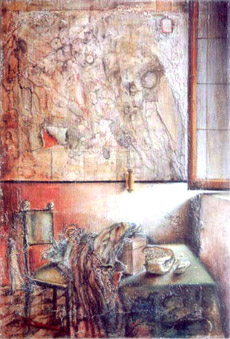
Leonid
Sejka, A
Room with Volcano Area Map,
1960
|
 |
today. Therefore, we can again talk about disintegration
of the state, which provokes growing insecurity
in the people and fears of the new and unknown,
producing not only existential concern, but also
political uncertainty; and in the view of cultural
consequences, it incites escape into the imaginary,
into collectivism and religious devotion
Anthropological/ethnical aspect of rebirth of
traditional nationalism and religiosity in the
new millennium is repressed for reasons of either
purely political explanations or clerical
|
concept of original
religiosity and national belonging, which
may be said to be a single-dimensional
interpretation, which is not groundless,
but is also insufficient to account for
the vitality of archaic consciousness.
In other words, instead of cyclical return
of paganism as an innate form of human
"archetypal consciousness",
we may rather talk about recurrence of
challenging social and historical periods,
which bring about temptations and cast
doubt on the rational (for the human mind
|
|
|
reachable) explanation of the world; and about
cyclical highs and lows in the influence of religious
and mythical ideas, which sometimes make people
engage in magic rituals, instead of taking individual
action and responsibility for improving their
situation.
The illusionary redemption (through mediation
of the church, and without any individual effort),
is presented as a more attractive solution than
the difficult and constant fight to change unfavorable
social conditions.
This can explain the renewed popularity of the
Kosovo myth, which is manipulated jointly by authorities
and the church. By presenting the medieval state
of Dusan's empire as a
model of Serbian statehood
(because of its size, created by war conquests
over the neighboring states) and turning
historical defeat of the Kosovo battle
into a victory (for choosing the kingdom
of heaven over the earthly kingdom, in
the name of clericalization of the state),
a psychological pressure is exerted on
people's minds, and a return to the past
is offered as an escape from the chaotic
present..
Finally, we should state why the thesis
about "primeval return of paganism"
in Serbs is not only theoretically unjustified,
but also dangerous in the practice of
social development. By implying an exclusively
synchronic approach, outside historical
trends, it suggests a static image of
the future, which offers as an explanation
only cyclical repetitions without alternatives.
Without a diachronic perspective and research
of historically continuous development
thread of human |
|
|
|
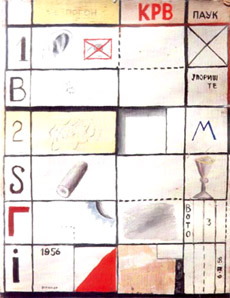
Leonid
Sejka, A
Non-Functional Form,
1956
|
|
needs and dispositions (or "cultural"
and "symbolic" capital, in the words
of Pierre Bourdieu), it is impossible to explain
different types of "habitus" and reasons
for their occurrence or for regressing to archaic
patterns of behavior. An organicistic interpretation
of social phenomena leads to a fatalistic view
of history ever-repeating itself, which deepens
and disseminates the feeling of resignation and
helplessness of individuals, who in our research
unconsciously accepted this attitude by saying:
"Everything is always the same", and
"Nothing can ever be changed".