As we said,
the worker Radislav Stojanov died
during a rally. It was a protest
rally of workers-shareholders
in the Zrenjanin-based company
Sinvoz.
The factory for railcar production
and overhaul - Sinvoz - initiated
privatization back in 1989,
|
in conformity
with the Law on Socially-Owned
Capital. By 1993, the
company workers bought
out 14% of the company
shares. After that, the
privatization was halted,
due to hyperinflation.
It was resumed in 2004,
in line with the new Privatization
Law, when 30% of shares
were distributed to workers
and pensioners without
compensation. The state
sold the remaining 56%
of the capital
|
|
|
|
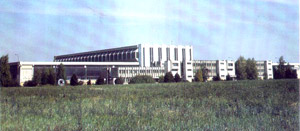
The
new factory for overhaul
of diesel and electric
railcars opened in 1975
|
 |
to Nebojsa Ivkovic, who participated
in the auction as an individual
and whose business or entrepreneurial
capacities are unknown. Ahead
of the sale of the 56% of the
capital, the company employed
some 870 workers.
In accordance with the agreement
signed with the Privatization
Agency, Ivkovic was required to
invest in Sinvoz, which would
grant him the right to increase
his stake. He apparently fulfilled
his commitment in 2005, when he
presented five battered diesel-electric
locomotives, acquired to be cut
into scrap metal, as an investment
into fixed assets. Qualified auditor,
Privredni savetnik - Revizija
company (Belgrade), certified
on 11 August 2005 that the investment
was made in line with the purchase
agreement, after which Ivkovic
was registered as the owner of
76% of Sinvoz shares.
Locomotives from the alleged investment
today remain in the same condition
they were in 2005 - resting on
the same stands they came on,
lacking wheels and even engines.
The workers-shareholders informed
the Privatization Agency on several
occasions about this "investments"
and demanded that execution of
contractual commitments be reviewed.
The Agency, on its own initiative
and at request of workers-shareholders,
sent several auditors in Sinvoz
(4 April 2004, 12 July and 24
October 2005, 17 April 2006 and
20 March 2007), and their reports
always claimed that the investment
was in conformity with the agreement.
Small shareholders had firm reasons
to doubt that the engines were
acquired by Ivkovic, and believed
that Sinvoz received them from
ZTP Beograd railway company, as
part of a 2005 settlement between
the two firms. However, neither
workers-shareholders nor Serbian
Government's Anti-Corruption Board
received relevant
|
|
|
information
from competent authorities,
so they complained to
the Commissioner for Information
of Public Importance.
Without any luck.
As they were not paid
their wages, Sinvoz workers
went on a strike. The
Ministry of Economy mediated
and the strike was suspended
after two weeks, but it
turned out that the majority
owner had no intention
to meet the strikers'
demands.
In 2007, Ivkovic completely
halted operations in the
factory and started dismissing
a growing number of workers
as "redundant".
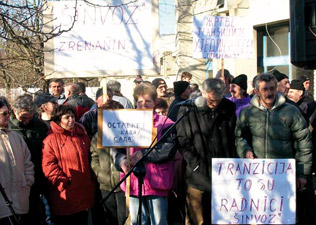
Workers-shareholders organized
several protest rallies
that year, demanding that
the Agency's agreement
with Ivkovic be terminated.
He, however, fired locksmith
Mita Lisica, president
of the Independent Union,
who was employed in Sinvoz
for over 20 years.
In November 2007, a bankruptcy
procedure was launched
for Sinvoz. The main creditors
were companies whose owner
was also Ivkovic. Before
|
|
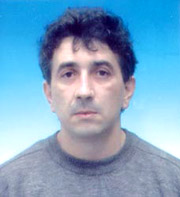
Mita
Lisica |
|
the bankruptcy was initiated,
Sinvoz employed 470 workers. On
the day when the company was declared
bankrupt, they all lost their
jobs.
When they found that Ivkovic was
again trying to falsify the investments
he was obligated to make, some
400 Sinvoz workers-shareholders
blocked the factory on 28 December,
demanding that the agreement with
Ivkovic be terminated and the
bankruptcy revoked. After many
years of government's procrastination
to assume its share of the responsibility
for disposal of its property and
for observance of laws and the
agreement, and under the pressure
of workers-shareholders' protest
and the public, on 31 January,
the line
|
ministry
informed that the disputed
agreement will be terminated.
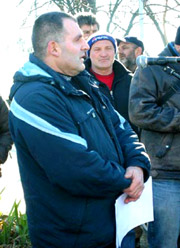
Protest leaders, headed
by Mita Lisica, told representatives
of the authorities they
would not leave their
offices till they receive
a document confirming
the annulment. We might
commend the authorities
for acting correctly,
and even for showing certain
sympathy for the workers'
sufferings. However, the
scrounged document was
probably a
|
|
|
result of the government's apprehension
that on that same day, 31 January,
another crowd of desperate protesters
would file in central Belgrade
and disturb spectacular rallies
of presidential hopefuls, whose
camps were feuding ahead of the
elections, promising a better
life and freedom from all troubles,
while circumventing the issues
that really ail the people and
push them into despair.

Instead of reaching a basic consensus
on the cornerstone for reconstruction
of the economy and the society
- which would involve norms concerning
ownership - once socially-owned
property was simply erased, without
any explanation as to what will
replace it and how; therefore,
it is uncertain on what new ownership
relations is the far-reaching
process of transition based on.
And without having this firmly
established by the constitution
and laws, a lot of room is created
for governmental arbitrariness
and different forms of systemic
corruption. Theft and plundering,
much talked about, and countless
scandals related with them, generate
a very unfavorable climate for
enterprise and business, and create
completely unreliable living conditions
for everyone, particularly for
those at the bottom of or outside
governmental hierarchy.
The government's
ledger, which was once focused
on "forcing us into socialism",
is now deployed for the purpose
of "forcing us into capitalism".
Sacrifice in defense of "blood
and
|
soil",
while denying oneself
life here and today, is
also imposed as a model,
especially to those who
are not in the power or
are distant from it, and
who are reprimanded for
their lack of "patriotism".
This not only threatens
barren existence of the
people, but also prevents
establishment of a normal
state where precise norms
- legal, ethical and political
- exist and regulate ownership,
"labor situation"
and the model of government
rule. Evidently, the most
powerful individuals -
financially and politically
- are comfortable with
having a
|
|
|
|
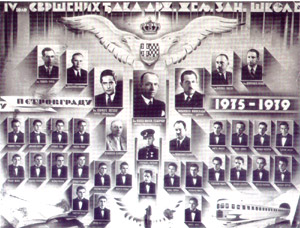
Graduates
of the fourth cycle of
Railway Vocational Training
School, which was a hub
of revolutionary fighters
in the Workshop and the
town
|
|
limbo state, where there is no
accounting - either for crimes
or for plundering, or for the
course and outcome of the transition.
The reasons to despair are abundant,
not only because the old regime
has regained strength, but also
because of rigid insistence on
the ideology and propagation of
"forcing into wild capitalism",
regardless of ownership and other
constitutional, legal and ethical
norms which capitalism itself
does recognize.
If protests of workers-shareholders
described here did not bring tangible
and direct benefits for the workers,
they may be of some use in sparking
a more serious public
|
interest
for their efforts to have
a general regulation of
property and civilized
relations between owner
and co-owners, and not
only for their suffering,
till they are killed.
Only when the state assumes
part of the responsibility
for its property, and
stops placing blame on
other owners and workers,
the otherwise painful
and risky process of transition
may lose some of its danger
and no longer be a fountain
of despair, from which
people are trying to break
away dramatically.
Though unexpected of the
people wrenching themselves
from despair, these workers
tell the cautionary tale
against the great danger
of proprietor's exclusiveness
and ruthlessness and suggest
the need for balancing
different
|
|
|
|
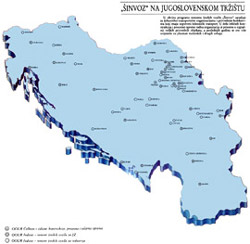
Sinvoz
on the Yugoslav market
|
|
ideas, norms and believes in order
to avoid describing anyone as
"redundant", which has
always been a ground for different
totalitarian systems. And when
this line is crossed, it makes
sense to think about freedom and
democracy and pursue that course,
even in Serbia, today and tomorrow.