Russian Serbian
Spring of the Middle Ages
Russian
"ours" on the Streets
In 2002, when Moscow's Citizens
Club informed Russian and international public
about what was going on in museum halls - in
the museum carrying the name of Andrey Sakharov
- to many it looked like an incident, but serious
Russian press did not see it that way and the
public was in uproar - for different reasons.
The event itself was not much of a novelty:
a group of prominent artists treated some biblical
themes quite unconventionally, especially the
Last Supper and the scene of Christ surrounded
by the apostles. A more numerous group of citizens,
calling themselves "believers" - who
carried icons and chanted akathists and troparions
- tore the paintings, attacked the artists and
the situation looked like it would turn into
a scene of public violence. The first group
of citizens and the artists alerted it was an
assault against freedom of artistic expression,
warning against the evil "spring of Russian
Middle Ages" and revival of inquisition.
The believers did not budge, and the police
did not care whether the word "inquisition"
was too strong - they prevented further violence
and apprehended the attackers. A pogrom was
avoided. Of course, the public prosecutor also
reacted, invoking Article 282 of the Russian
Federation Criminal Code - claiming the dignity
of the state and the Church was offended, and
the case reached a court - where the things
took an unexpected turn, as the artists were
prosecuted, instead of those who assaulted them.
The artists defended themselves the best way
they could, though the Criminal Code does not
contain any article concerning the crime of
"sacrilege". The battle on the public
scene was unequal - with artists on the one
side, and the state and Russian Orthodox Church,
supported by a rowdy bunch of believers, on
the other. Moscow artists failed to move the
state prosecutor, the Russian Orthodox Church
or the aggressive "believers". What
the believers were saying resonated better with
the audience. These kinds of groups are now
|
mushrooming throughout
Russia, like some sort of party militia
of V.V. Putin's party, but also as an
aggressive "God's police"
that terrorizes people and monitors
whether they fast or make weddings when
they should be fasting. Their political
role is prominent and only few are not
afraid of them, because they are exploited
by the state, police structures and
also by the Russian Orthodox Church,
which is becoming an increasing presence
on the public scene in Russia today.
"Now the priests" - claim
those who signed the Appeal - "are
what red commissars used to be".
Daily politics is taking its toll -
both in Russia and in Serbia. Russia
has a long and glorious tradition of
|
|
|
|
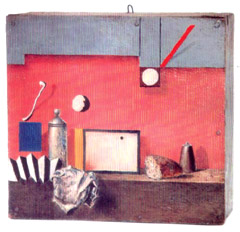
Leonid
Sejka, Pink
Still Life,
1967
|
 |
Enlightenment and democratic
thought and we have to admit it knows how
to preserve it.
Our problem lies elsewhere - we resemble Russia
in everything that is wrong and ill with it.
"The Diocese of Zica believes" -
as Pravoslavlje (Orthodox Christianity) paper
cited the Minister of Religion, on 15 September
2004 - "that a Constitution should be
adopted first, which would pronounce Orthodox
Christianity as the state religion, and Serbian
Orthodox Church as the state church".
Luckily, the request was rejected, but there
are many other things to remind us of Russia.
His Grace Pahomije of Vranje took to court
Nikola Dzafo and Zivko Grozdanic because of
their ART-clinic exhibits. The court itself
is baffled, but newspaper reports suggest
this may be a preparation for "the 21st
century inquisition". It may seem like
overreacting, but you never know - in case
of need, even Russia is not too far. Some
church dignitaries have violated citizens'
rights of the believers, guaranteed by the
constitution, without any legal repercussions.
The Bishop of Bac banned Teatro die Venti
play that has a deep humanistic and Christian
message, and spent days kowtowing in Novi
Sad squares, aided by gendarmerie, startling
the citizens with his exorcist exercises.
The typical National Socialist racial theories
are aired freely - while no one seems to care.
And so on and so forth - we seem to resemble
Russia too much. A distant Russia, long gone,
to which even the reasonable Russians had
said goodbye. And let us end here - forever
- this futile discussion about new quacks
and new anti-cultural barbarians.
|
| |
Mirko
Djordjevic |
|
|