|
|
|
| |
|
|
|
|
How the supreme
government body in Serbia works
Hints of Parliamentarianism
The session
of the National Parliament, adjourned in July,
was resumed in September: international agreements
were ratified, a "new national consensus"
was announced and then postponed - what was
really going on?
Nebojsa Popov
After the noisy May elections and tumultuous
haggling over composition of the new government,
the agenda of the Parliamentary session scheduled
for 21 July contained the following items: (1)
ratification of the Stabilization and Association
Agreement (SAA) with the European Union, (2)
oil and gas (OG) arrangement with the Russian
Federation, (3) eleven loan agreements worth
EUR286.5 million and (4) the government's policy
on Kosovo and Metohija. The session was interrupted-adjourned
at the very opening, without a clear explanation
(presumably to avoid the turmoil caused by the
arrest of Radovan Karadzic, which took place
on that very day). It was resumed on 02 September.
After a five-day debate that lasted some 40
hours with around 300 rebuttals, MPs voted for
ratification of all agreements (140 voted for
the SAA, 214 for the OG), while the last item
was removed from the agenda.
As I watched the TV broadcast of the entire
course of the session, I will highlight for
our readers some important characteristics of
the developments, without going into picturesque
details that the dailies reported at length.
The conflict
of values
In the multitude of rebuttals dominated by
personal and party conflicts that created a
lot of media buzz, we are interested in the
adversarial ideological and political views
and, even more, in clashes of internal values
of the main actors. Instead of assuming that
the "disintegration of all values"
has taken place, concrete values become visible
by following "yes" and "no"
votes in relation to agreements on the agenda.
The reasons for ratification of all agreements,
primarily those presented in exposé of Deputy
Prime Minister Bozidar Djelic, were prevailingly
economic ones, such as contribution to revival
and development of the economy, with emphasis
placed on utilization of the EU pre-accession
funds and the exulting agitation ("let's
go, let's go" to the place where the living
is better). G 17+ party whip Suzana Grubjesic
spoke in a similar manner, but more reasonably,
highlighting the polarization: for or against
the road to Europe. Aleksandra Jerkov's (League
of Social Democrats of Vojvodina) speech took
the same course, with particular emphasis on
the idiosyncrasy of Vojvodina and its resistance
to robbery.
Civilization-related and cultural arguments
came from members of the ruling majority. Dragoljub
Micunovic (Democratic Party) highlighted the
importance of the European road for Serbia,
which went beyond economic framework, and emphasized
that the majority of Serbian citizens had already
moved from the sidetrack. G 17+ MP Sasa Milenic,
a philosophy professor in a high school, attempted
to prove, knowingly and inspiringly, that foundations
for Serbia's road to Europe could be found in
Serbian cultural and political history. He stressed
that past, present and future should be valued
equally and that the European Union is an open-ended
project that has a place for value pluralism.
This opinion, which is rarely heard in our public,
was followed by an ardent discussion that ranged
from the commonplace disqualifications for "trying
to be smart" or "philosophizing",
through counterpoising "orthodox spirituality"
against Western-type materialism (Gordana Pop-Lazic,
Serbian Radical Party), to claims that he was
motivated by treason and hatred against Serbs
(Natasa Jovanovic, Serbian Radical Party).
The reasons for rejecting the SAA, beside sneering
at the "fairytales about Europe" and
Euro-fanatics, and repeated accusations of being
"servants and lackeys" of the West,
were also the alleged animosity of the western
powers toward Serbs and Serbia. This supposedly
culminated in the recent wars - the NATO bombing
in particular and the acknowledgment of Kosovo's
independence by the majority of EU member states,
which are now all assailing to "colonize"
us. The theory about conspiracy against Serbia
was also revived (Slobodan Samardzic, Democratic
Party of Serbia). Anti-Serb orientation of the
Hague Tribunal was often cited. Radicals added
to this all the vile intention to murder their
leader Vojislav Seselj in the "casemate".
As regards the agreement with Russia, the radicals
and the populists (Democratic Party of Serbia,
New Serbia) stressed ideological and political
reasons to ratify it: the traditional Slavic
and Orthodox ties (Slavism and Russophilia),
reliance on its growing power and its expected
protection and support in relation to the Kosovo
issue. They even expressed readiness to abandon
economic rationality and limit the country's
sovereignty.
The exit from the utter confrontation was offered
by the leader of the Radicals in the Parliament,
Tomislav Nikolic, who proposed an amendment
to the SAA ratification by inserting a paragraph
that would "tie the government down"
and obligate all Serbian politicians to defend
territorial integrity and sovereignty of Serbia
in any arrangement with the EU. Representatives
of the ruling majority accepted this amendment.
A "new national compromise" was even
announced triumphantly. The compromise was accepted
by many MPs, except those from the Democratic
Party of Serbia and New Serbia. Support came
from the Liberal Democratic Party even. Cedomir
Jovanovic saw in this a chance to overcome not
only confrontations in the parliament, but also
the fatal division of the entire Serbia into
proponents and opponents of European integrations.
Power and
property
Already in the SAA debate,
the issue of management of Serbian resources was
opened. There were even suspicions that Serbia
was content to provide privileges for the western
capital, while questioning the one coming from
Russia (Jorgovanka Tabakovic, Serbian Radical
Party). The discussion peaked at the OG arrangement,
with LDP MPs (Jovanovic, Ostojic, Maras, Micic,
Prokic, Korac etc.) as the main participants.
They said they supported cooperation with Russia
and economic agreements in general, but presented
very concrete remarks. They objected that the
Russian partner would receive a dominant and monopolistic
position, primarily by acquiring a minimum of
51% of shares. Furthermore, they remarked that
the NIS price was not market-determined and was
highly underestimated. They also noted that the
seat of the future company was unknown, which
generates the question if the company would be
obligated by Serbian laws and what court would
be competent to decide in case of disputes, remarking
that social program was
|
missing etc. It is not
even certain where the gas pipeline will
be placed, or whether it will be a major
or a side leg (a small stream), they remarked.
Unlike the MPs from the radical and populist
parties, which exulted this agreement
as "historic", "the guarantee
of living for the next hundred years",
the liberal opposition believed it was
"damaging", "shameful"
even, especially because "the sovereignty
would be ceded too lightly".
|
|
|
|
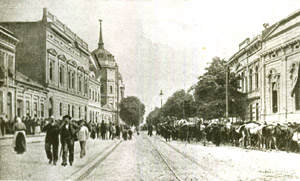
King Milan's Street,
1903, Belgrade City Museum
|
 |
Representatives of the League of Social Democrats
of Vojvodina (Kostres and Jerkov) said that "national
interests would be sold shamefully", especially
by plundering of Vojvodina. They all demanded
concrete explanations from the government, which
would help them decide whether to accept the agreement,
but received no proper reply.
The polemics only touched on a major issue: who
has the authority and responsibility to manage
the natural and economic resources of the country?
Who is the owner? In the time of SFR Yugoslavia,
the constitutional category of "socially-owned
property", which was in essence "everyone's
but no one's", actually served to hide the
usurping property monopoly of the power mongers.
Without changes to the constitution that would
remove the screens for usurpation and set foundations
for private and public property, we have had the
"wild privatization", without clear
constitutional, legal or moral principles; which
has created space in turn for new usurpations.
Results of thorough research (by Vesna Pesic and
others) showed that new actual monopolies of senior
party officials (and tycoons) have been created,
as they have distributed power and property like
their fiefdoms in proportion to election results.
Numerous findings of the Corruption Council, headed
by Verica Barac, have supplied convincing proofs
of systemic corruption, particularly in the biggest
frauds (Sartid, sugar scandal, Nacionalna Stedionica
etc.).
A part of the public and authors in this magazine
have insisted that the parties gathered around
Democratic Opposition of Serbia should keep their
promise given in 2000: promptly after fall of
the Milosevic's regime, elections would be called
for a Constitutional Assembly. The Assembly would
adopt a new constitution and thus end the unlawfulness,
establish normative and institutional foundations
for a normal economy, society and state. However,
all four post-Milosevic governments ignored that.
A new constitution was adopted late in 2006, but
it did not emanate from the expected widest social
consensus on property, political, social and cultural
foundations of the new constitution - Kosovo and
a contest in patriotism were placed in its center,
instead. The Democratic Party participated in
this with its proclaimed policy of "cohabitation",
which was after the latest May elections reinforced
with announcements of "national reconciliation"
with parties of the former regime, primarily the
SPS - the "brotherly left".
We may conclude that thanks to certain compromises,
the session of the National Parliament was unblocked
and completed. Some hints of a more stable system
of parliamentarianism were also noted. However,
these hints brought no lasting results, as some
were annulled even during the session, both by
those in power and by the opposition. Even the
realization of the ratified agreements is uncertain.
We need not repeat here all the benefits of Serbia's
EU accession. It would be suitable, however, to
keep an eye on the developments until that happens.
The "civil society" propaganda or copying
of European standards and laws are not futile,
but there will not be much benefit from a new
Resava School 1
if we are uncertain about the nature of the society
emerging here or whether the laws will be respected
at all. Vital values are related with real affirmation
of parliamentarianism in our own country. It is
certain, however, that there can be no parliamentarianism
as long as we eschew adopting a constitution that
would reliably regulate property forms and relations,
norms and institutions. Without it, there remains
a wide area of chaotic clashes and confrontations
dominated by different fundamentalist and militant
ideologies and politics. They have ruled over
the past decades and now they stubbornly
resist to sanctioning of crimes and robbery. Without
stable institutions, primarily the parliament,
the only authoritative measure will be the balance
of power, a constant scuffle to overpower the
other, to reach Dedinje 2
or send someone to Zabela 3,
depending on whose "collection time is due".
Beside the real inherited problems, this is all
facilitated by a systemic reduction of Serbian
political, social and cultural history to its
fractions proclaimed by different militant groups
as the only Serbian tradition - their ideology
and propaganda, in fact (this was evident in the
attacks at prudent words of the philosophy professor
we quoted). Some aspects of the said reduction
have already found their place in critical analyses.
Some were suggested by recent investigation of
consequences of the regime's confrontation with
the "black wave in culture", after 1968.
There are many facts that still have not been
revealed, primarily in the area of culture, including
concrete values and systems of values. Thorough
research, critical reviews and new visions of
changes are yet to take place in that area.
1 A copying
and translation center set up in the then Resava
(now Manasija) Monastery in the 14th century.
2 Elite part
of Belgrade
3 A prison
in Serbia
|
|
|
 |
|
1st - 31st October
2008 |
|
| |
|
|
|
|
|
| This is an abridged version of the original
text published in the Serbian issue of the magazine. |
|
|
|
|